
Host guide
How to Photograph Your Listing's Amenities Like a Hotel Would
A coffee steaming next to the espresso machine. A table set for dinner. The fireplace lit. For decades, photography that showed a property's life — not just its walls — was a luxury-hotel production: models, stylists, art directors, days of shooting. That production is now available to any listing, for less than the cost of the coffee in the photo.
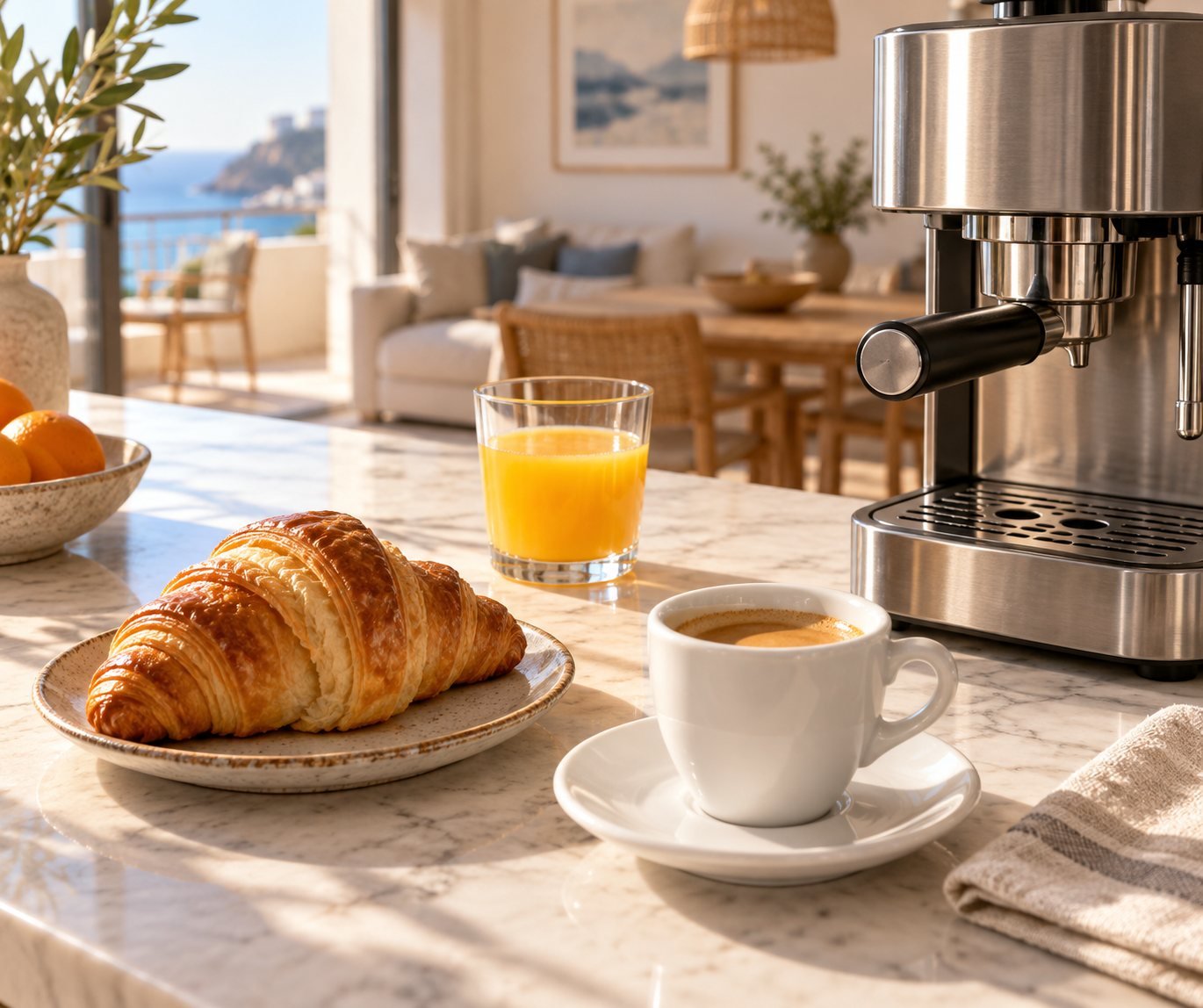
Guests don't book walls. They book the stay.
The tourism-marketing industry has a name for photos that show a property being enjoyed rather than merely described: lifestyle photography. Tambourine's hotel-photography guide defines it as capturing a moment and a narrative so that potential guests can visualise a stay and form an emotional connection — and it describes these shoots as materially more complex than basic room photography, involving models, locations, set design, stylists, hair and makeup, and wardrobe. That complexity is exactly why ordinary listings never had it. And a 2020 study in the International Journal of Hospitality Management (Back and colleagues, 247 customers) found the underlying mechanism: larger, more immersive photography increased a viewer's feeling of being "transported" into the experience — which in turn raised booking intention and willingness to pay more. Interestingly, for large photographs the effect was strongest without people in the frame: scale and atmosphere do the selling, not faces.
Sources: Tambourine, The Hotel Photography Guide · Back et al., 2020 (study record).
What hotels actually paid for this
To put today's options in perspective, here is what the traditional production looked like:
- A 2013 pricing breakdown published by A Photo Editor shows a Wonderful Machine estimate for an independent high-end resort: two shoot days, 10 scenarios, 20 intended images — with a scenario/licensing fee of $8,000 before assistants, three rental days, lodging, post-production, travel, meals and equipment (the estimate lists $300/day for camera bodies, $300/day for strobe kits and roughly $235/day for grip). The client supplied wardrobe, props, food, catering and styling; scenes used the resort's own staff plus one to four non-professional talents.
- A three-day, ~25-person production with 12 models and 45 costumes is documented in Gray Malin's behind-the-scenes account of his 2018 Beverly Hills Hotel series, shot across 12 hotel locations with a year of development. That was a fine-art/lifestyle series rather than a hotel's marketing campaign — but it shows the machinery a fully produced aspirational image has behind it.
Sources: A Photo Editor, January 2013 · Gray Malin, On Set at The Beverly Hills Hotel.
What photography like this is worth in bookings
- Airbnb's own program page reports that, comparing more than 14,700 professionally photographed listings with more than 62,300 others worldwide in 2024–2025, professional photography listings saw a 21% increase in host earnings and 19% more bookings. Airbnb labels these as its own comparative analysis, not a guarantee — treat them as strong platform evidence with marketing attached.
- A peer-reviewed study in Management Science (Zhang, Lee, Singh & Srinivasan, 2022), covering 7,423 properties over 16 months with difference-in-differences analysis, found listings that acquired Airbnb's verified photography had 8.98% higher occupancy than listings with host-taken photos.
Sources: Airbnb Pro Photography · Zhang et al., 2022 (record).
The scenes that do the work — and how you get them now
You do not need 12 models and 45 costumes. What reads as "this stay is beautiful" at thumbnail speed is a handful of small, believable scenes — and these are exactly the one-tap enhancements Superphoto applies to the photos you already have:
- The coffee moment. An espresso cup at the machine, a coffee and croissant on the counter — the classic "morning here" scene, now generated realistically into your own kitchen photo.
- The kitchen working. Cooking ware on the ceramic hob demonstrates that the kitchen actually cooks; a fruit bowl on the countertop does the same in softer light.
- The table set. A properly set dining table turns an empty room into a dinner.
- The evening scene. Lamps switched on, the fireplace lit, a tasteful image on the TV — the amenities guests try to imagine themselves using after dark.
- The work corner. A laptop placed on the desk signals remote-work readiness without a word of description.
- The view. Window Pull keeps the sea, the sky, the greenery visible through the glass instead of a white blur — plus greenery made greener and a clear blue-sky day when the weather refused to cooperate.
What we deliberately do not add is people. The research above suggests large hero images work best without human presence, and your guests want to picture themselves there — not somebody else's holiday.
How to shoot the parts only you can capture
Some amenities must come from your own camera, and they are worth ten minutes each:
- Pool and jacuzzi: shoot in the hour after sunrise or before sunset, from a low angle along the water so the surface catches the light; keep the phone level and let the Blue Sky enhancement handle the rest.
- Playgrounds and family spaces: shoot tidy and empty-looking at eye level; the space tells the story. Resist cluttering the frame to "prove" it is child-friendly.
- Outdoor dining and seating: one golden-hour wide shot, one detail (cushions, a set table, fairy lights on).
The capture technique that makes all of these look right is covered in our iPhone photography guide — height, level, exposure, focus.
Make it a batch, keep it consistent
The last thing separating your gallery from a hotel's: one visual standard. Enhance the whole set in one run — every photo gets the same brightness, colour and geometry, so the gallery reads as a single considered story rather than a montage. You compare each result with its original and approve what gets published; nothing goes live without your eyes on it.